GST Full Form: Meaning, Components, and How It Impacts Businesses Globally
Introduction
Goods and Services Tax, commonly known as GST, is one of the most significant tax reforms in modern business systems worldwide. It simplifies the taxation process by replacing multiple indirect taxes with a single, unified tax. GST impacts businesses, consumers, and governments by streamlining operations, improving compliance, and enhancing transparency. Understanding the GST Full form, key components, and global importance is essential for professionals, entrepreneurs, and students engaged in commerce and finance..
The Full Form and Meaning
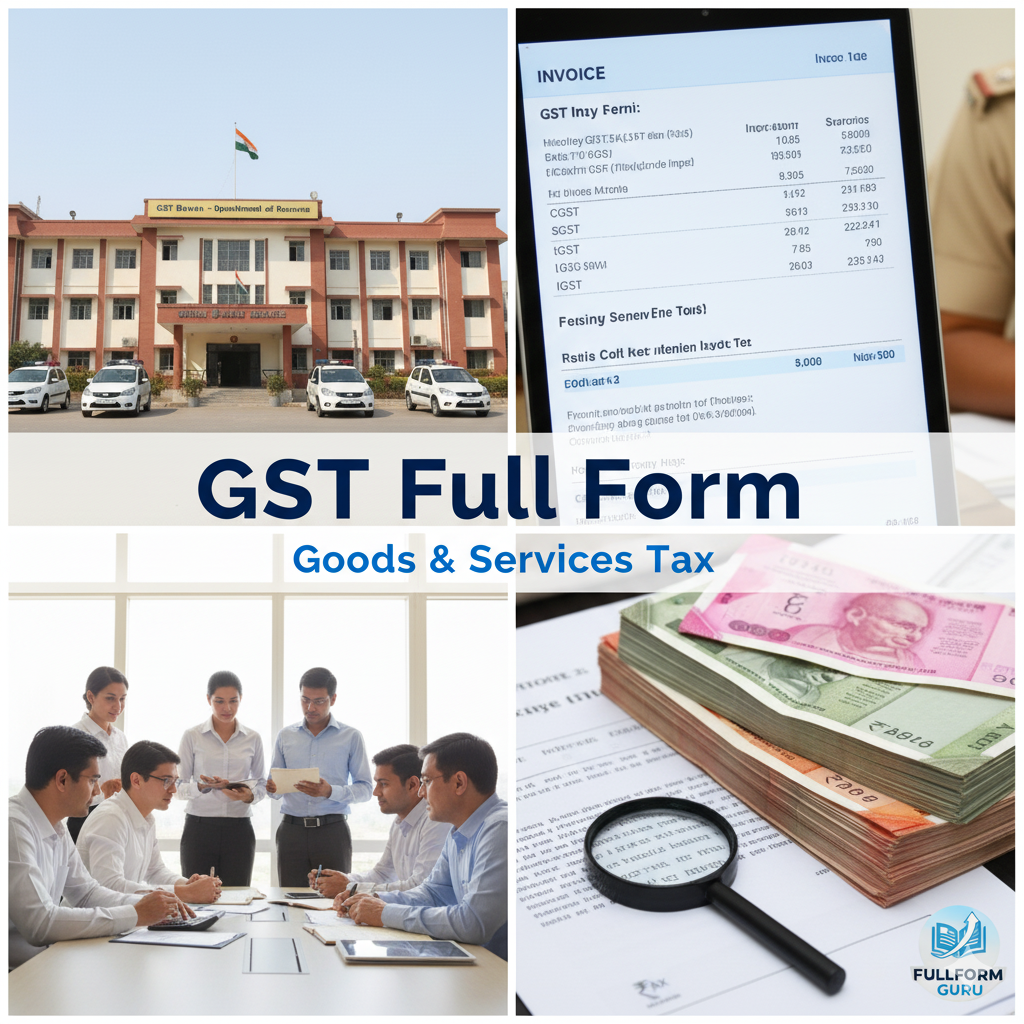
GST stands for Goods and Services Tax. This understanding of the GST Full Form helps clarify why it is considered a unified tax system worldwide. It is a comprehensive indirect tax applied to the supply of goods and services.
The purpose of GST is to create a single, uniform taxation system that eliminates the complexity of multiple state and central taxes. By consolidating taxes, GST ensures smoother business operations and reduces the cascading effect of taxes, minimizing tax-on-tax and improving efficiency for businesses and consumers.
Role and Importance of GST
GST plays an essential role in modern taxation by simplifying the tax system and ensuring transparency. It replaces multiple indirect taxes such as service tax, value-added tax, and excise duty, creating a single system applicable across all regions. Businesses benefit from reduced compliance burdens, while governments can track tax collection more efficiently.
The importance of GST also lies in its ability to boost economic growth. Standardizing tax rates and reducing tax-related disputes encourages investment, streamlines supply chains, and ensures fair competition among businesses. Consumers gain from transparent pricing and the elimination of hidden taxes. Understanding the Full Form of GST within the framework of tax reforms makes the concept much clearer.
Types and Components of GST
GST consists of several components designed to cover different aspects of goods and services taxation. The main types include:
- Central GST (CGST): This is the portion of GST that the central government charges when the sale or service occurs within the same state.
- State GST (SGST): State GST is the tax collected by state governments on transactions that occur within a single state.
- Integrated GST (IGST): Applied on inter-state transactions and imports, shared between the central and state governments.
- Union Territory GST (UTGST): Applicable in union territories without a legislature, similar to SGST.
Knowing the components also gives a deeper understanding of the GST Full Form and its application in various regions.
Mini-Table for Clarity:
| GST Component | Applicability | Collected By |
| CGST | Intra-state goods/services | Central Government |
| SGST | Intra-state goods/services | State Government |
| IGST | Inter-state transactions | Central Government |
| UTGST | Union territories | Union Territory Govt |
Eligibility and Basic Requirements
Meeting eligibility criteria and basic requirements is essential for GST compliance or roles related to GST:
- Business Registration: Any business exceeding the prescribed turnover threshold is required to register under GST.
- Legal Entity: Individuals, partnerships, or companies can register, provided they have proper legal documentation.
- Tax Identification: A valid tax identification number or equivalent government-issued proof is required.
- Basic Knowledge of Accounting: Understanding invoices, receipts, and financial records is necessary for accurate GST reporting.
- Access to Technology: Businesses and professionals require internet access and familiarity with online GST portals for compliance and filing.
Meeting these requirements ensures efficient registration, accurate reporting, and compliance with GST laws.
Step-by-Step Process / How GST Works
Understanding how GST works helps businesses comply efficiently and avoid penalties. Many companies first try to understand the GST Full Form before exploring how input tax credit and tax returns function. The procedure follows these straightforward steps:
- Registration – Businesses meeting the turnover threshold must register under GST with the relevant tax authorities.
- Invoice Generation – For every sale or supply, a GST-compliant invoice must record the transaction and indicate the applicable tax rates.
- Tax Collection – Businesses collect GST from customers on taxable goods or services at the prescribed rate.
- Input Tax Credit – Businesses can claim input tax credit for GST paid on purchases used in operations, reducing their total tax liability.
- Filing Returns – Businesses must submit regular GST returns online, reporting sales, purchases, tax collected, and input credits.
- Payment of Tax – Businesses are required to remit any net GST due, after accounting for input tax credits, promptly to the government.
Following this step-by-step workflow ensures compliance and prevents issues with audits or penalties.
Preparation or Actionable Strategy
To manage GST efficiently, businesses and professionals can follow these practical steps:
- Stay Updated on Tax Rates – Regularly review GST updates to remain compliant with regulations.
- Use Accounting Software – Employ accounting or ERP software that supports GST calculation and reporting.
- Maintain Proper Records – Keep all invoices, purchase receipts, and tax documents organized for audits and filing tax returns.
- Train Staff – Ensure employees handling billing, accounting, or procurement understand GST rules and procedures.
- Consult Tax Professionals – Seek advice from tax consultants for complex transactions or international business dealings.
- Plan Cash Flow – Plan cash flow carefully to ensure timely GST payment and avoid penalties.
These strategies help businesses reduce errors, optimize tax credit claims, and maintain smooth operations under GST regulations.
Career Opportunities / Benefits / Application
Understanding and managing GST can open several career opportunities and offer benefits to professionals and businesses. Some key roles and applications include:
- GST Consultant – Advising businesses on GST compliance, filing, and optimization strategies.
- Tax Analyst – Monitoring GST trends, analyzing transactions, and preparing reports for management.
- Accountant / Finance Professional – Handling GST-related entries, invoicing, and tax return preparation.
- Compliance Officer – Ensuring organizations follow GST rules and preparing for audits.
- Business Owner / Entrepreneur – Implementing efficient GST practices to optimize costs and cash flow.
- Trainer / Educator – Teaching GST concepts to students, professionals, or corporate teams.
The knowledge of GST not only ensures legal compliance but also provides opportunities for career growth, consultancy services, and enhanced business efficiency globally. Professionals who understand the Full Form of GST have an advantage in securing finance and tax-related roles.
Comparison with Similar Topics or Alternatives
GST is commonly compared with other indirect or consumption-based taxes. Here is a compact mini-table to highlight key differences and similarities:
| Feature | GST | Traditional Sales Tax | Value Added Tax (VAT) | Excise Duty |
| Scope | Broad, unified across goods and services | Limited to goods | Goods and some services | Specific goods production |
| Tax Structure | Multi-stage, destination-based | Single-stage, origin-based | Multi-stage, origin-based | Single-stage |
| Input Tax Credit | Available at all stages | Limited or not available | Partial availability | Not applicable |
| Global Relevance | Implemented in many countries worldwide | Limited use | Common in several countries | Mostly local or country-specific |
| Ease of Compliance | Simplified filing with digital systems | Often complex | Moderate complexity | Specific rules per product |
The comparison highlights that GST streamlines multiple indirect taxes, offering businesses a transparent and efficient system globally.
How to Get Started – Practical Steps
Starting with GST for your business or learning its processes involves a few key steps:
- Understand GST Basics – Familiarize yourself with the Full form, types, and purpose of GST.
- Register for GST – If you run a business, complete registration for Goods and Services Tax (GST) through official portals.
- Learn Filing Procedures – Understand how to file returns, input tax credits, and payment schedules.
- Adopt Digital Tools – Use accounting software or apps that integrate GST calculations to simplify compliance.
- Stay Updated – Follow news, official updates, and amendments in GST rules and rates.
- Attend Workshops or Online Courses – Enhance your knowledge with structured learning or expert guidance.
These steps help ensure smooth implementation of GST, whether for personal understanding or business compliance.
Conclusion
In conclusion, GST, which stands for Goods and Services Tax, is a vital system for modern businesses and governments worldwide. By simplifying indirect taxation, enhancing transparency, and promoting efficiency, GST enables organizations to manage operations and finances effectively. Understanding its components, types, and compliance procedures empowers professionals and business owners to make informed decisions and optimize financial planning.
With consistent learning, proper application, and attention to detail, anyone can master GST concepts and use them to succeed in global business. Embrace the knowledge of GST as a tool to streamline operations, reduce errors, and create long-term value for your professional and business growth. A strong understanding of the GST Full Form (Goods and Services Tax) allows businesses to manage compliance more effectively.
Author
About the Author